

Why Your AC Runs All Day in San Diego Heat
My Guy is Proud to Be "Your Guy" for Your Home
Your central air conditioning can feel like it is working a double shift during a San Diego heat spell. If the house never quite cools down, the steady hum and rising energy bills get old fast.
Sometimes your cooling system is expected to run longer during extreme temperatures. However, when it runs hour after hour and the thermostat barely moves, the system or the home itself is asking for help.
That difference matters, especially if you have an AC running constantly in Carlsbad or another North County neighborhood.
Key Takeaways
- Normal vs. Abnormal Runtime: While longer cooling cycles are common during extreme San Diego heat, an AC running nonstop that fails to reach the set indoor temperature signals an underlying issue.
- Common Culprits: Restricted airflow from dirty filters, low refrigerant levels, dirty condenser coils, and leaking ductwork are the primary reasons a system struggles to satisfy your thermostat.
- The Importance of Airflow: When your system cannot cycle off, it is often because heat is entering the home faster than the unit can remove it or because airflow blockages are preventing efficient operation.
- When to Call for Help: If you notice signs like warm air blowing from vents, ice on the refrigerant lines, or a significant spike in energy costs, it is time to schedule a professional diagnostic check rather than continuing to adjust your thermostat.
When all-day cooling is normal, and when it signals trouble
On hot afternoons, longer cooling cycles are common. Your system is removing heat from the home continuously, and that takes time when outdoor temperatures climb.
A steady cooling cycle during peak heat does not always mean a breakdown. Many systems are sized for normal summer conditions, not necessarily the hottest day of the season. Longer cycles can also keep your indoor temperature more even throughout the day.
Still, there is a clear line between working hard and falling behind. If your unit runs from late morning into the evening and the indoor temperature stays several degrees above the thermostat setting, something is off.
That problem can show up in different ways across San Diego County. In Carlsbad, homes near the coast may get some relief from the marine layer, but coastal humidity and sunlight hitting west-facing windows can still turn rooms into ovens by late afternoon. Farther inland, places like Escondido and San Marcos often reach higher temperatures, so the same system has to fight a larger heat load.
Nonstop cooling is also different from short cycling. Short cycling means the system turns on and off too often, which strains internal parts. Constant running usually points to low cooling power, poor airflow, or too much heat entering the house.
If your AC runs through the hottest part of the afternoon, that may be normal. If it runs all day and still misses the set indoor temperature, it needs attention.
The most common reasons your air conditioning won’t shut off
Restricted airflow is one of the biggest causes of an overworked system. Dirty air filters, blocked vents, obstructed air returns, or a dirty evaporator coil can slow airflow enough that cool air never reaches your rooms effectively.
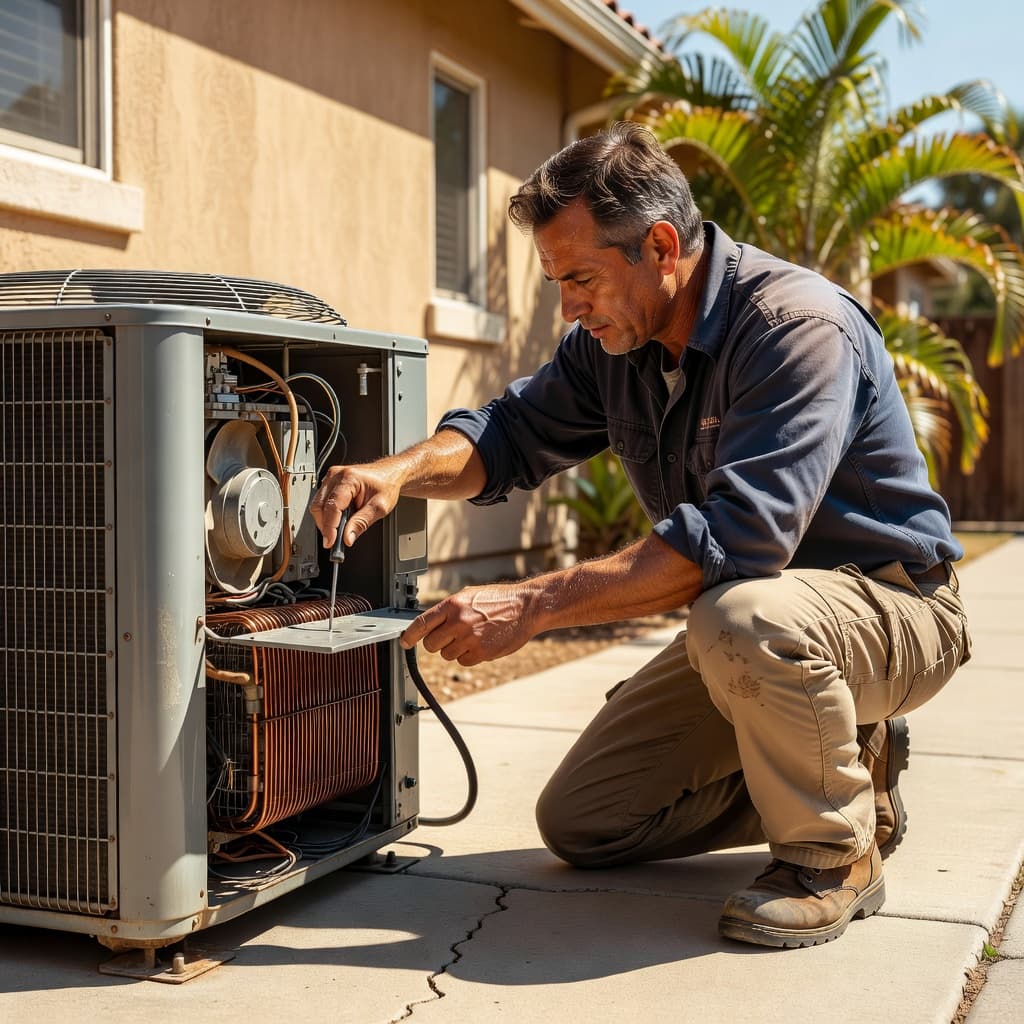
Low refrigerant is another frequent culprit. Because refrigerant does not get used up like fuel, a low charge usually points to a refrigerant leak. When this happens, your air conditioner loses cooling power and may run for hours without ever reaching the desired temperature. You might also notice weak cooling, a frozen evaporator coil, ice on the refrigerant line, or unusually warm air blowing from the vents. If your system still uses older Freon, a leak can be particularly problematic for both performance and the environment.
The outdoor unit is equally important. If the condenser coil is coated with dust, leaves, or lint, it cannot release heat efficiently. As a result, the entire HVAC system works harder to provide less cooling. Aging systems can struggle even more, and if you have an undersized AC unit that does not match your home’s total heat load calculation, the system will never be able to cycle off during the hottest parts of the day.
Ductwork problems are a hidden issue in many homes. Cooled air can spill into the attic or crawl space instead of reaching your living areas. Thermostat placement also causes trouble. If the thermostat sits near a sunny wall, a warm hallway, or a busy kitchen, it may keep calling for cooling long after the rest of the home is comfortable.
This quick table shows how a few common issues affect runtime:
| Problem | What you notice | What it leads to |
|---|---|---|
| Dirty air filters or coil | Weak airflow, slow cooling | Long run times, higher bills |
| Refrigerant leak | Warm air, ice, poor cooling | Constant operation, compressor strain |
| Ductwork problems | Hot spots, uneven rooms | Lost cooling, longer cycles |
| Undersized AC unit | Set temp never reached | All-day operation on hot days |
| Blocked vents | Stagnant air, poor circulation | Longer cycles, HVAC system fatigue |
The pattern is simple. When airflow drops or the home gains heat faster than the system can remove it, the AC keeps running with little progress.
For a homeowner with an AC running constantly in Carlsbad, the answer is often a mix of sun exposure, duct loss, and overdue maintenance. That is why solid AC repair starts with a full HVAC check, not a quick part swap. The same airflow issues that hurt summer cooling can also drag down winter heating performance.
Safe DIY checks before you schedule AC repair
A few basic checks can solve small problems. They will not fix a leak or an electrical fault, but they can rule out simple issues before you call for service.
Start with the easy items:
- Replace dirty air filters if they look gray, are packed with dust, or have been in place for too long.
- Make sure supply and return vents are fully open and not blocked by rugs, furniture, or curtains.
- Set the thermostat settings to auto so you can judge true cooling cycles accurately.
- Clear leaves, weeds, and debris around the outdoor condenser. Leave at least a couple feet of space around it.
- Close blinds on west-facing windows during late afternoon to cut solar heat.
Then watch what happens over the next few hours. If the indoor temperature starts dropping again, the problem may have been minor airflow problems or excess heat gain.
Skip the risky DIY fixes. Refrigerant cans, electrical troubleshooting, and opening sealed panels can make a small problem more expensive. A frozen coil, tripped breaker, or outdoor unit that hums but will not start is not a homeowner job.
If the thermostat still will not reach the desired temperature after those checks, it is time for a professional AC repair service. Constant adjustments to the thermostat do not help. They only keep the system working longer.
When nonstop cooling turns into an HVAC service call
Some warning signs call for prompt professional attention. Warm air from the vents, ice on the line, water pooling around the indoor unit, or a breaker that trips repeatedly all point to a problem that will not fix itself. You might also notice sticky indoor air, which suggests your system is struggling to dehumidify your home effectively.
A sharp jump in your energy bills is another major clue. If your cooling habits have not changed but the cost has, your system may be losing efficiency or experiencing restricted airflow. At that point, you should contact a professional AC repair service to measure system performance. A qualified HVAC contractor will evaluate your unit by checking refrigerant pressure, temperature split, blower motor strength, electrical components, the condensate drain system, and overall duct condition.
Age also matters. If the unit is 12 to 15 years old and struggles every summer, repair costs can start piling up. That does not mean replacement is automatic. It does mean the system should be evaluated as a whole, comparing the current performance to your home requirements. An expert will look at ductwork, insulation, thermostat location, and whether you are dealing with an undersized unit or an oversized AC system that cycles improperly.
Across Vista, Oceanside, and Fallbrook, many homeowners notice the same pattern. The AC seemed fine in spring, then the first hot stretch exposed a problem that had been building for months.
Regular care is the best way to prevent these issues. Routine maintenance helps more than many people think. By keeping coils clean, testing capacitors, clearing the condensate drain system, and ensuring accurate controls, you help the system cool better now and heat better later. Since cooling and heating share parts of the same airflow path, neglect in one season often shows up in the next.
Final thoughts
When your air conditioner runs all day, it is not always failing. Often, your HVAC system is communicating that the house is gaining heat too fast, airflow is restricted, or cooling power has slipped.
The strongest clue is a missed set temperature. If the air conditioner runs for hours and still cannot hit the thermostat setting, the problem is bigger than a hot afternoon.
If you want a professional to take a look before the next heat spike, you can Book Online.
FAQs
Is it normal for an air conditioner to run all day during a San Diego heat wave?
Longer cycles during the hottest part of the day are expected. What is not normal is an air conditioner that runs nearly nonstop and still leaves the house feeling too warm. If the indoor temperature stays several degrees above your thermostat settings for hours, your cooling system or the home itself likely has an underlying problem.
Why is my air conditioner running constantly in Carlsbad but my neighbor’s is not?
Homes do not gain heat the same way. Factors like window direction, attic insulation, duct leaks, thermostat location, and unit size all change how hard an air conditioner has to work to maintain a comfortable environment. A house with more afternoon sun or leaky ductwork can struggle to stay cool even if the outdoor temperature is identical to your neighbor’s property.
Can dirty air filters make my air conditioning run nonstop?
Yes, they can. When you use dirty air filters, you restrict essential airflow, which makes the cooling process weaker and causes the unit to run for longer periods. In some cases, poor airflow from dirty air filters can even freeze the indoor evaporator coil. Once the coil freezes, cooling performance drops further and the air conditioner runtime becomes even worse.
Should I keep adjusting my thermostat settings if the house will not cool?
No. Lowering your thermostat settings will not fix a weak or malfunctioning air conditioner. It often just forces the unit to run even longer without reaching the target temperature. Set the thermostat to a reasonable level and monitor whether the air conditioner can reach it. If the house remains warm, schedule professional maintenance instead of chasing the temperature setting lower.