

Wildfire Smoke AC Filters Escondido Homeowners Need
My Guy is Proud to Be "Your Guy" for Your Home
Wildfire smoke AC filters Escondido homeowners buy should capture more than visible ash. The smallest particles can remain invisible, pass through weak filters, and circulate indoors.
During San Diego County fire weather, check the air quality index through AirNow or another official source. Particle pollution can change quickly, so prepare before wildfire season and follow local health guidance.
Keep windows and doors closed when conditions worsen. A clean filter, sealed home, and correctly operated air conditioning system support indoor air quality. A DIY air cleaner can provide brief room-level backup when additional filtration is needed.
Key Takeaways
- Choose a compatible MERV 13 filter for wildfire smoke, but confirm your HVAC system can handle the added airflow resistance before upgrading.
- During poor air quality, keep windows and doors closed, turn off whole-house fans, seal smoke entry points, and run central air conditioning in recirculate mode when appropriate.
- Inspect filters weekly during active wildfire conditions and replace them early if they look loaded, smell smoky, or reduce airflow.
- A portable HEPA air cleaner or carefully assembled DIY Corsi-Rosenthal box can provide room-level filtration when central HVAC filtration is limited.
- Stop the system and schedule professional service if you notice weak airflow, icing, unusual sounds, repeated shutdowns, or uneven cooling after changing the filter.
Why Wildfire Smoke Clogs AC Filters So Quickly
Smoke from wildfires contains gases, soot, ash, and fine particulate matter. PM2.5 particles measure 2.5 micrometers or smaller, so they can travel deep into the lungs. Exposure to wildfire smoke can aggravate asthma, allergies, COPD, and other respiratory health issues, especially for sensitive people.
Typical furnace air filters catch dust, hair, and larger debris. However, smoke leaves a much finer coating across the filter’s pleats. As that layer builds, your HVAC system has to work harder to move air. You may notice weaker airflow, longer cooling cycles, a dusty smell, or rooms that never seem to cool evenly. A DIY air cleaner can supplement filtration in one room when the HVAC filter loads quickly.
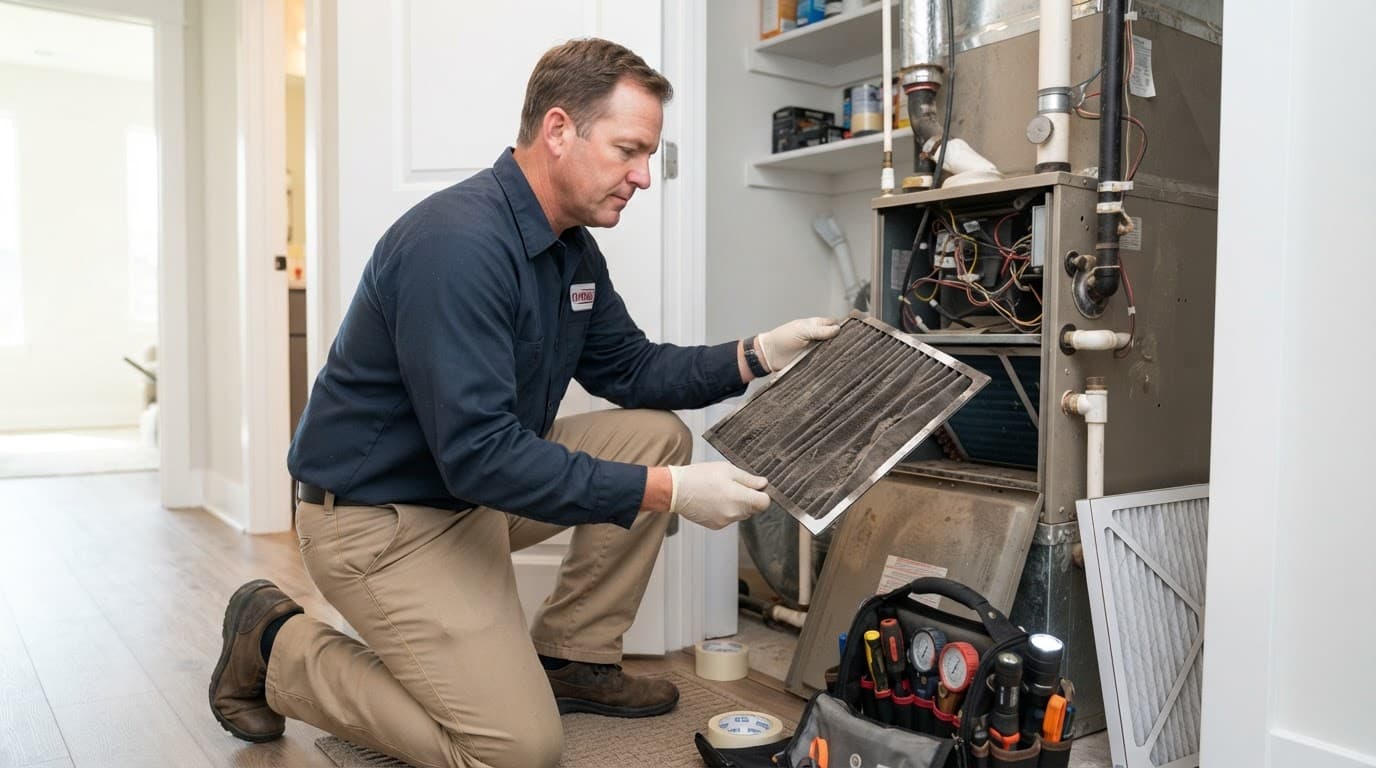
For Escondido homes, hot afternoons can make that restriction more noticeable, especially during wildfire season. Your system needs steady airflow to protect the indoor coil and control humidity. Check AirNow and local San Diego County air alerts for the current air quality index before opening windows or running outdoor ventilation equipment. An indoor monitor can help you track indoor air quality as outdoor conditions change.
A filter that looks only lightly gray can still restrict airflow, so inspect it more often during poor outdoor air conditions.
Choosing Filters for Escondido Homes During Wildfire Smoke
For most compatible residential systems, a MERV 13 rating is the practical target during a wildfire smoke event. It captures a meaningful share of the fine particulate matter found in smoke while allowing more airflow than many higher-rated filters.
Use this quick comparison when selecting a replacement:
| Filter option | Smoke filtration | Best use |
|---|---|---|
| MERV 8 | Limited for fine smoke particles | Normal dust and basic household debris |
| MERV 11 | Better particle capture | A step up when MERV 13 is not compatible |
| MERV 13 | Strong balance of filtration and airflow | Smoke protection in compatible systems |
| Portable air cleaner | Excellent fine-particle capture in one room | Bedrooms, nurseries, or homes with limited HVAC filtration |
When the HVAC system can’t support a more restrictive filter, a DIY air cleaner offers a lower-cost, room-level fallback.
A higher number is not always the safer choice. A high-efficiency filter can add substantial resistance, especially when it’s a thin one-inch filter. If your system was not designed for it, the added resistance can cause blower motor strain and reduce cooling performance.
Check Your System Before Upgrading
Check the size printed on the existing air conditioner filter. Common furnace air filters often use one-inch sizes, while four-inch or five-inch media cabinets may support higher ratings. Confirm your air filtration system’s capacity before wildfire season, using the manual or an HVAC professional.
Don’t stack filters or force a thick filter into a shallow slot. Air must pass through the filter rather than around it. The arrow on the frame should point toward the blower or furnace cabinet. For more help comparing sizes and ratings, review these air filter buying tips.
An older Vista furnace blower may not tolerate a sudden jump to a restrictive filter. If airflow drops after an upgrade, return to the highest compatible rating and use a portable cleaner in the rooms you occupy most.
Running Central Air Conditioning During Hazardous Air
Most whole-home systems recirculate indoor air. They don’t pull outdoor air through the condenser. Still, some homes have a fresh air intake or outdoor-air damper. Whole-house fans and leaky ductwork can also bring wildfire smoke inside.
Keep windows and exterior doors closed. Turn off whole-house fans. Close the fresh air intake and any outside-air damper, if your system has either. Set the thermostat fan to recirculate mode during a heavy smoke period if your equipment can handle extended operation. This sends more indoor air through the filter and can support indoor air quality.
Continuous fan use does increase electricity use. It also pushes a dirty filter toward its limit faster. During wildfire season, check the filter every few days, especially during a prolonged event. A Poway heating system can run its blower for filtration, but it still needs enough airflow to operate safely.
A portable air cleaner can supplement filtration in occupied rooms while the system recirculates indoor air. A DIY air cleaner can provide another room-level option.
Many Carlsbad homes have a separate return grille in a hallway or ceiling. Keep furniture, rugs, and closed doors from blocking return airflow. If the air conditioning system produces little air, makes new noise, freezes, or shuts down repeatedly, turn it off. Arrange AC repair in San Diego before further use.
Set Window Air Conditioner and Portable A/C Units to Recirculate
Close the fresh-air vent on a window air conditioner or portable air conditioner. Many units already recirculate room air, but gaps around the frame can still admit smoke. Seal those gaps with removable weatherstripping or painter’s tape to keep smoke particles out.
Single-hose portable units exhaust indoor air outdoors. That action can draw smoky air through cracks elsewhere in the home. A dual-hose model reduces that effect, although it still needs a tightly sealed window panel. A/C in Oceanside needs the same smoke precautions when inland fire weather sends wildfire smoke toward the coast.
Replace Filters Earlier and Seal Smoke Entry Points
During normal conditions, many homes replace filters every one to three months. During wildfire season, inspect an air conditioner filter with a MERV 13 rating weekly, adjusting for smoke intensity and visible loading. Persistent odor or weaker airflow calls for early filter replacement, rather than waiting for the calendar.
Keep one or two correctly sized replacement filters and materials for a DIY air cleaner at home before wildfire season begins. The best filters for Escondido homes are compatible with the system and available when air quality deteriorates. After a wildfire smoke event, inspect the filter again, even if the calendar says it is not due.
Routine AC maintenance services can also identify duct leaks, dirty coils, and blower issues that make smoke filtration less effective.
Close the Small Gaps That Let Smoke Drift In
Filters help only after smoke enters the return air path. Keeping sealed windows and doors closed reduces indoor contamination and helps protect indoor air quality.
- Close windows, exterior doors, fireplace dampers, and pet doors during poor air quality.
- Press temporary weatherstripping into loose window tracks and use painter’s tape around obvious gaps.
- Place rolled towels at exterior door thresholds if smoke is entering beneath the door.
- Avoid exhaust fans unless necessary, since they can pull replacement air through leaks.
- Never block combustion-air openings, dryer vents, or gas appliance vents.
Portable HEPA Filters, a DIY air cleaner, and the Corsi-Rosenthal box
A portable air cleaner adds room-level protection during wildfire smoke events, especially in bedrooms. It can support indoor air quality when central filtration cannot keep up. Choose a unit with a true HEPA air filter and a clean air delivery rate sized for the room.
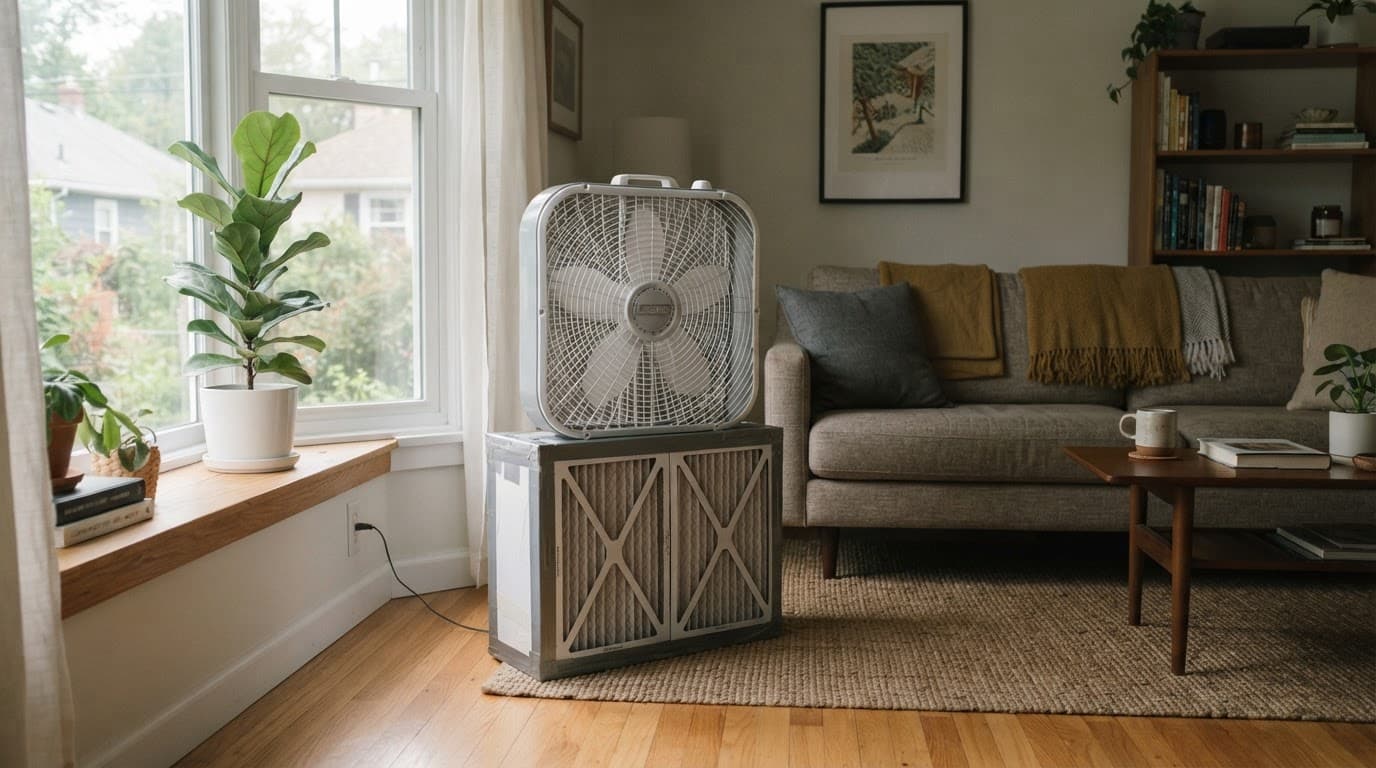
For a clean room setup, place the portable air cleaner where people spend the most time. Keep windows closed, leave clearance around its intake and outlet, and run it at a higher setting while occupied. Close the room’s door to keep filtration focused on that space.
As part of wildfire season preparation, check the unit’s room rating and gather replacement filters.
A DIY air cleaner can help when a HEPA unit isn’t available. The box fan air purifier requires a clean 20-inch box fan and a matching 20-by-20-inch MERV 13 high-efficiency filter. Also gather painter’s tape and cardboard for a shroud.
- Build the DIY air cleaner by placing the filter against the fan’s intake side, with its arrow pointing toward the fan.
- Tape the filter edges to the fan frame so air can’t bypass the filter.
- For a Corsi-Rosenthal box approach, add a cardboard shroud to the fan’s outward-facing side. Run the fan on low or medium.
Keep the fan, filter, tape, and cardboard available before wildfire season conditions worsen. Use a modern, stable fan in a dry location, and don’t leave it running unattended. Activated carbon filters may help with some odors or gases, but they don’t replace particle filtration. This DIY air cleaner isn’t a substitute for a portable air cleaner or certified HEPA device, but it can reduce fine particulate matter and smoke particles in a closed room during wildfire smoke events.
Clearing the Air Safely
Wildfire smoke makes a compatible MERV 13 filter, sealed windows, and recirculated central air conditioning especially important. During wildfire season, a DIY air cleaner or portable air cleaner can support occupied rooms. Together, these options create a practical air filtration system.
If your air conditioning system develops weak airflow or icing after a filter change, stop operation and schedule an evaluation. Unusual sounds or repeated shutdowns also need attention. Schedule service or Book Online to have your system checked. Planning before the next wildfire season can help you prepare.
Frequently Asked Questions
How often should I change an air conditioner filter during wildfire smoke?
Inspect it every week during active conditions, especially during wildfire season. Replace it early if it is visibly loaded, smells smoky, or reduces airflow. Filter replacement may be needed within weeks, not months, with heavy use.
Can a MERV 13 filter damage an older HVAC system?
A MERV 13 filter won’t damage equipment when the system can handle it. Problems occur when a restrictive filter reduces airflow beyond what an older blower can manage. Check compatibility before upgrading, especially with a thin one-inch filter.
Should I run my thermostat fan continuously during smoke?
During wildfire season, set the system to recirculate mode to improve filtration because more air passes through the filter. However, it raises power use and may strain a clogged filter or weak blower. Use it during the worst conditions, and check airflow often.
Does a window air conditioner bring smoke indoors?
A window air conditioner usually recirculates indoor air, but an outside-air setting can draw pollutants indoors. Close the fresh air intake when outdoor conditions are hazardous, if the unit allows it, and seal loose gaps around the frame.
Can I use a DIY air cleaner instead of a portable air cleaner?
A box fan air purifier can reduce particles in one enclosed room, but a properly rated room cleaner with a true HEPA air filter offers more reliable filtration. This setup is often called a Corsi-Rosenthal box and requires careful assembly. Use it as a temporary option, not your only indoor air strategy.
When should I call for help with wildfire smoke?
Call when a filter upgrade causes weak airflow, ice on indoor equipment, unusual blower sounds, or uneven cooling. These symptoms can indicate a filter mismatch, duct problem, dirty coil, or blower issue.