

San Diego Commercial HVAC Maintenance Checklist
My Guy is Proud to Be "Your Guy" for Your Home
An air conditioner rarely fails without warning. Before it quits, tenants may report warm rooms, strange odors, rising utility bills, or a thermostat that never seems to catch up.
Commercial HVAC maintenance gives business owners a chance to catch those signals before they turn into an interrupted workday or an expensive replacement. For San Diego properties, steady cooling demand, coastal air, dust, and changing occupancy can all strain equipment.
Use this checklist for HVAC preventive maintenance. It protects comfort, indoor air quality, and the commercial HVAC system your business depends on.
Key Takeaways
- A written commercial HVAC maintenance plan helps San Diego businesses catch warning signs early, protect comfort, and reduce emergency repairs.
- Use weekly and monthly staff checks, quarterly inspections, and professional service before peak cooling and heating seasons.
- Match maintenance to the equipment, climate, occupancy, and airflow needs of the property. Filters, coils, drains, ducts, controls, and ventilation all affect system performance and indoor air quality.
- Staff should handle only low-risk observations and filter checks. Electrical, gas, refrigerant, rooftop, and internal equipment work requires a qualified HVAC technician.
- Keep accurate service, refrigerant, permit, and equipment records so future maintenance decisions are easier and regulatory requirements can be met.
Why San Diego businesses need a maintenance plan
Commercial systems work harder than a typical home unit. A rooftop package unit may cool several zones. Air handlers, controls, dampers, and ventilation systems must distribute and condition air throughout a commercial building. A documented preventive maintenance plan gives facility managers a way to track issues and schedule recurring inspections in CMMS software.
When one piece slips, trouble can spread. HVAC preventive maintenance helps identify developing problems before a system failure. A dirty coil raises operating pressure, while restricted airflow can freeze an evaporator coil. A clogged condensate drain can cause ceiling or wall damage.
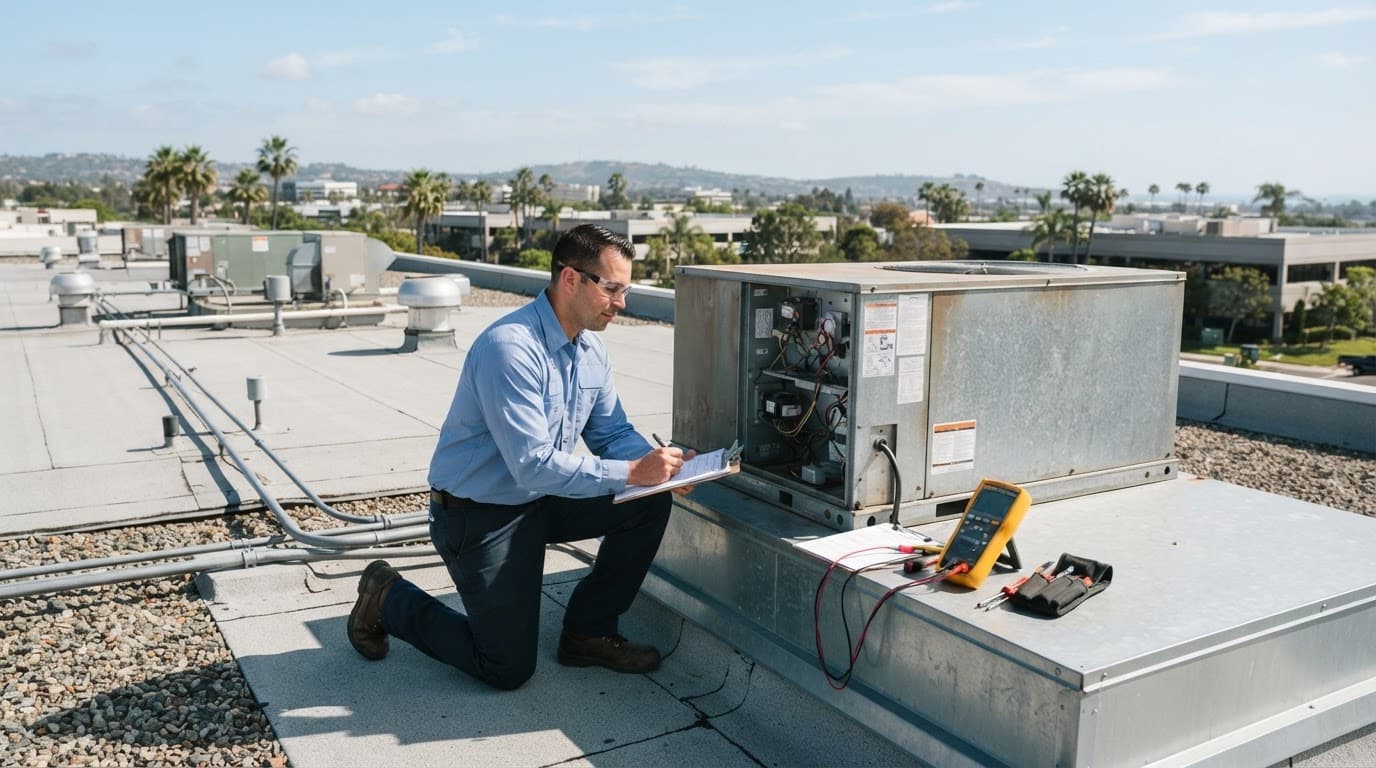
San Diego weather creates its own maintenance demands
Commercial HVAC maintenance in San Diego should account for long cooling seasons, dry inland dust, and salt exposure near the coast. Businesses in Escondido, Vista, San Marcos, Carlsbad, Oceanside, Fallbrook, and Poway can face different operating conditions, even when they use similar equipment.
Coastal properties may see corrosion on outdoor electrical connections and condenser components, while dry inland sites may collect more dust. A busy restaurant, gym, salon, or retail store loads filters faster than a low-traffic office. Regular inspections give technicians a baseline, making small performance changes easier to spot.
Commercial HVAC maintenance checklist by schedule
A preventive maintenance schedule gives onsite staff clear tasks and reserves technical work for qualified professionals. This HVAC preventive maintenance approach should reflect your building’s hours, equipment age, and occupancy. If your team uses CMMS software, assign recurring tasks and record completion there.
| Interval | Tasks for onsite staff | Tasks for an HVAC technician |
|---|---|---|
| Weekly | Note temperature complaints, unusual noise, water, and thermostat alerts. | Address urgent operating problems. |
| Monthly | Inspect air filters, clear access around outdoor equipment, and check visible drains. | Review recurring faults if staff logs show patterns. |
| Quarterly | Confirm vents are open and report odors or weak airflow. | Check belts, motors, electrical components, drains, coils, and controls. |
| Spring and fall | Review service records and schedule visits before peak heating and cooling demand. | Test cooling or heating operation, check refrigerant levels and system performance, and verify safeties and airflow. |
Filter replacement depends on occupancy, filter type, and pressure drop. A crowded workspace can need attention much sooner than a lightly used suite.
Prepare before cooling and heating peaks
Before summer, have a technician clean condenser coils, inspect cooling components and fan motors, test capacitors and contactors, check drain performance, and verify thermostat settings. This work supports energy efficiency by helping air conditioning equipment shed heat instead of running longer to reach setpoint.
Before cooler weather, schedule a heating check as part of HVAC preventive maintenance. For a gas-fired furnace, that means inspecting heating components, ignition, burners, venting, safety controls, and the heat exchanger. A technician should handle combustion testing and any work inside the cabinet.
A clean filter does not prove a system is healthy. It cannot reveal a loose electrical connection, a failing capacitor, or a refrigerant leak.
Following this schedule supports operational efficiency throughout the year.
Match maintenance to the equipment on your property
Commercial HVAC maintenance changes with the system type and access conditions. Effective HVAC preventive maintenance uses procedures suited to each system. A good service visit starts with an HVAC equipment inventory, including model numbers, locations, age, filter sizes, served areas, and accessible air handlers.
Rooftop units and split systems need access and airflow
Rooftop units often face direct sun, windblown debris, and neglected clearance around condenser sections. The inspection should cover cabinet panels, coil condition, drains, belts, blower assemblies, electrical connections, economizers when installed, and other cooling components.
Split systems need similar attention to coils and refrigerant lines. Their indoor air handlers, however, can be hidden above ceilings or in closets. Stains around ceiling tiles, weak airflow, and persistent water near an indoor unit deserve a prompt inspection.
Heat pumps, VRF systems, and chillers need specialized care
Heat pumps need seasonal mode checks and defrost verification. Technicians should inspect heating and cooling components and check refrigerant levels. VRF systems have multiple indoor units and controls, so technicians should use manufacturer-approved procedures and identify faults by zone.
Chillers and larger hydronic systems add pumps, water treatment, valves, and more complex controls. These systems need a documented service plan, not an occasional call after occupants complain.
Air filters, ducts, and indoor air quality
Indoor air quality affects employees, customers, and anyone spending long hours inside your building. Start with airflow. Poor airflow in supply and return paths, or weak ventilation systems, often creates comfort complaints before the thermostat shows an obvious problem.
Treat filters as part of the system, not an afterthought
Select filters that your equipment can handle. A higher MERV rating can capture finer particles, yet an overly restrictive filter may raise static pressure and reduce airflow if the system was not designed for it.
Make filter maintenance part of preventive maintenance: inspect filters regularly, replace dirty filters, and ensure a snug fit without gaps. Check return grilles for dust buildup and blocked supply vents as part of a broader HVAC preventive maintenance program. A dirty evaporator coil can trap heat, force longer runtimes, and reduce energy efficiency.
If certain rooms stay stuffy or hot after filter service, the issue may be damaged or poorly balanced ductwork that affects indoor air quality. Professional HVAC duct repair and replacement can address leaks, disconnected runs, and airflow restrictions that a thermostat adjustment will not fix.
DIY checks that are safe for business owners
DIY checks have a limited role in commercial HVAC maintenance. Staff can monitor basic conditions and report changes early, but they shouldn’t open equipment cabinets or work on electrical, gas, rooftop, or refrigerant systems. Those tasks require trained service technicians.
Keep a short owner-maintained log
Onsite staff can complete a few low-risk checks without opening equipment cabinets. Larger operations can use CMMS software to organize these observations with other maintenance records:
- Record room temperatures, the thermostat settings staff observed, customer complaints, odors, and the time each issue occurs.
- Check accessible filters and replace them only with the correct approved size.
- Keep boxes, landscaping, and trash away from outdoor condenser equipment.
- Report water stains, standing water, repeated breaker trips, or new grinding sounds right away to help avoid emergency repairs.
Those notes help a technician find intermittent problems. They also reveal whether a complaint affects one zone or the whole building.
Call for AC repair before a small problem grows
Repeated short cycling, ice on refrigerant lines, burning smells, water leaks, or a unit that blows warm air need professional attention. Don’t remove panels, reset breakers repeatedly, or add refrigerant. Restarting a breaker may hide the symptom, but it won’t repair the cause.
For sudden cooling trouble, arrange commercial AC repair in Escondido rather than asking staff to remove panels, reset breakers, or add refrigerant. The same caution applies to A/C equipment on rooftops, where fall hazards and electrical risks add another layer of concern.
Refrigerant, ventilation, and permit records
Maintenance is also a recordkeeping job for a commercial building. Organized records support standalone preventive maintenance decisions and HVAC preventive maintenance planning. CMMS software stores inspection reports, refrigerant documentation, permits, and corrective actions. A well-organized file makes it easier to compare performance and plan equipment replacement before a system fails during business hours.
Refrigerant and ventilation work requires documentation
Anyone who opens a refrigerant circuit must hold EPA Section 608 certification. Beginning January 1, 2026, EPA leak-repair requirements apply to certain appliances with a refrigerant charge of 15 pounds or more. Verify the current federal requirements for the equipment and location, and retain documentation for regulatory compliance.
California workplace ventilation rules may call for annual HVAC inspections and written maintenance records for ventilation systems, depending on location and current requirements. Keep the service date, technician name, findings, corrective work, and refrigerant added with the equipment file.
ASHRAE 62.1 guides discussions about ventilation systems in commercial spaces, while ASHRAE 55 addresses thermal comfort. Both are useful benchmarks when a building has recurring stale-air or temperature complaints.
Know when service turns into permit work
The City of San Diego exempts some routine tasks, such as replacing filters or faulty controls without removing installed equipment. However, depending on the work scope, a rooftop unit replacement, major duct alteration, or larger control retrofit can require a mechanical permit. Requirements also vary by location, so verify current rules before approving major work.
Make the checklist easy to follow
CMMS software can help facility managers at larger properties track each unit’s service history. Smaller businesses can get similar value from a shared spreadsheet or digital folder.
Record details that make future service faster
List every HVAC asset, its location, model number, filter size, installation date, warranty details, and last service date. Accurate records make future preventive maintenance planning easier.
At each visit, record temperature split, amperage readings, static pressure, refrigerant work, and recommended repairs. Use CMMS software to attach technician reports, photos, invoices, and notes about recurring issues. A local provider offering commercial HVAC maintenance and repair can turn those readings and service records into a plan that matches your equipment and business hours, supporting operational efficiency.
Frequently Asked Questions
How are commercial HVAC systems different from residential systems?
Commercial units serve larger spaces, multiple zones, and longer operating hours. They may include rooftop units, air handlers, economizers, building controls, and greater ventilation demands. This added complexity requires more detailed inspections than a typical home system.
How often should a business schedule professional maintenance?
Most businesses benefit from professional service twice a year, before cooling season and before heating season. High-use buildings, food service locations, medical-adjacent spaces, and older equipment may need quarterly visits.
Why does filter replacement matter so much?
A loaded filter restricts airflow. Reduced airflow makes the blower work harder and can leave coils dirty or frozen. Rooms may also heat or cool unevenly. Timely filter changes support cleaner indoor air, too.
Can staff handle a furnace or electrical problem?
Staff should report the issue and keep people away from unsafe equipment. A trained technician should inspect gas lines, combustion components, electrical connections, refrigerant circuits, and internal controls.
Keep Comfort Predictable All Year
A written commercial HVAC maintenance routine helps extend equipment lifespan. It turns small warning signs into planned service before they lead to a system failure or emergency repairs.
Clean filters, clear coils, sound electrical parts, reliable cooling components, correct airflow, and complete records all protect the system’s daily performance.
If deferred service has piled up, Book Online for an inspection and a maintenance plan that fits your building’s equipment and hours.