

Why Furnaces Blow Cold Air in Escondido Homes
My Guy is Proud to Be "Your Guy" for Your Home
Cold air blowing from the vents on a chilly Escondido morning gets your attention fast. If your furnace runs but the house stays cold, the problem may be simple, or it may point to a mechanical issue that requires professional attention.
Because many local homes spend more time on air conditioning than heating, small heating system issues can sit unnoticed for months. When the first truly cool night of the season arrives, many residents find themselves dealing with a furnace blowing cold air unexpectedly. Start by performing a few easy checks, then watch for signs that your system needs professional service.
Key Takeaways
- Check Your Settings First: Many instances of a furnace blowing cold air are caused by simple user errors, such as a thermostat set to ‘ON’ instead of ‘AUTO’ or a system still configured for cooling mode after the summer months.
- Address Airflow Issues: A dirty, clogged air filter is a leading cause of cold air, as restricted airflow triggers the furnace’s high-limit switch, which shuts off the burners to prevent overheating.
- Perform Basic Troubleshooting: Homeowners can resolve many common issues by checking their circuit breakers, replacing dirty filters, and ensuring that all return grilles and vents remain unobstructed.
- Know When to Call a Pro: If basic resets and filter changes do not restore heat, or if you encounter red flags like the smell of gas, loud banging, or soot buildup, turn off the system immediately and contact a qualified HVAC technician.
When cold air is normal, and when it isn’t
Not every burst of cool air means the furnace is broken. Many systems push room-temperature air for a minute or two when the blower starts before the burners fully warm the heat exchanger.
You may also feel slightly cooler air at the end of a cycle. That is often the blower clearing leftover heat from the unit, which is normal.
The more common false alarm in Escondido involves your thermostat settings. After a long cooling season, the system may still be set to cool, or the blower fan may be set to ON instead of AUTO. When the blower fan is set to ON, it can circulate unheated air between heating cycles and make it seem like the furnace is not working correctly.
This quick guide helps separate normal behavior from a real problem:
| What you notice | Likely reason | First check |
|---|---|---|
| Cool air for 1 to 2 minutes at startup | Normal warm-up | Wait a few minutes |
| Blower fan runs all the time | Thermostat settings on ON | Switch fan to AUTO |
| Cold air right after summer | Mode set to cool | Set mode to heat |
| Air turns cold after burners shut off | Furnace hit a safety limit | Clogged filter |
| No heat at all | Pilot light issue | Check pilot light |
If your furnace is still blowing cold air after several minutes, or the air never warms at all, the issue is no longer normal startup behavior. At that point, the system is either failing to generate heat, or it is shutting the heat off to protect itself.
The most common causes inside the furnace
A steady stream of cold air usually means something interrupted the heating cycle. In many cases, the blower still runs because the circuit board is attempting to move air or because the unit is trying to prevent overheating.
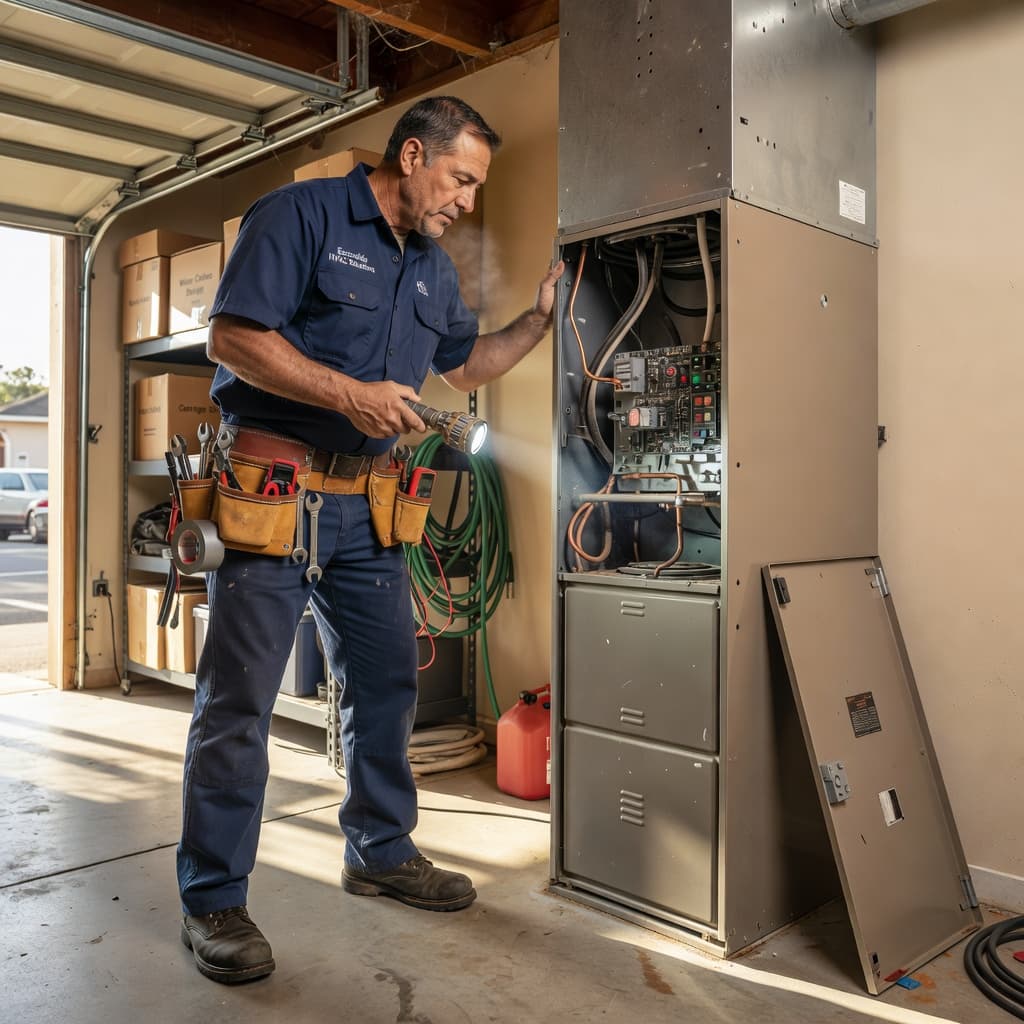
A quick inspection often reveals if the problem stems from restricted airflow, ignition failure, or a safety shutoff.
A dirty air filter is one of the most common culprits. When airflow drops significantly, the furnace is prone to overheating. Once this happens, the high-limit switch shuts the burners down, though the blower may continue to operate. The result is a system that feels like it turned cold halfway through the cycle.
Ignition failure is another frequent issue. Older units may experience a pilot light problem, while newer models often struggle with a dirty flame sensor, a worn igniter, or a faulty gas valve. In these cases, the burners may ignite and extinguish quickly, or they may never stay lit long enough to warm the air.
Turn the furnace off and call for help if you smell gas, see soot, or hear loud banging when it tries to start.
A high-efficiency furnace adds a few more potential failure points. A blocked condensate line, pressure switch malfunction, or vent obstruction can prevent the burner from staying on. Most homeowners will not be able to identify these internal components, but an HVAC technician can test them quickly.
Problems with ductwork leaks can also add to the confusion. If air escapes from the ducts before it reaches your living space, the house will feel drafty. Additionally, closed air vents and blocked return grilles significantly impede airflow. When the system cannot circulate air as intended, performance drops and the unit often begins short cycling.
If the burners will not stay lit, the unit starts short cycling, or the air never warms up, it is time to contact a professional for furnace repair in Escondido.
DIY checks that are safe for homeowners
You do not need specialized tools to begin basic furnace troubleshooting. Performing a few safe checks can save you time and may even resolve the issue without professional intervention.
Start with the thermostat and work outward by following these steps:
- Adjust your thermostat settings to ensure the system is set to heat and the temperature is 3 to 5 degrees above the current room temperature.
- Switch the fan setting from ON to AUTO if it is not already in that position.
- Perform an air filter replacement if your current filter looks gray, dusty, or clogged with debris.
- Check the furnace power switch and the circuit breaker panel to ensure power is reaching the unit.
- Make sure all air vents in your rooms are open and verify that no furniture or rugs are blocking the main return grille.
- If you have a high-efficiency furnace, check the exterior of your home for any leaves or debris around the intake and exhaust pipes.
These steps matter because many heating service calls begin with simple airflow or control issues rather than failed internal components. It is quite common for the same thermostat that ran your air conditioning last month to remain in an incorrect mode.
Still, some fixes are not meant for homeowners. Avoid removing burner covers, attempting to relight modern electronic ignition systems, or repeatedly hitting the reset button. Frequent restarts may mask the underlying problem for an hour, only to leave you without heat again later that night.
If you have completed your air filter replacement, verified your thermostat settings, and the furnace still blows cold air after 15 minutes, it is time to stop. Residents in Escondido, Vista, San Marcos, and Poway often encounter these issues during the first cold snap of the year. If these simple steps do not work, you should contact a qualified HVAC technician for a proper diagnosis. To get started, you can schedule professional furnace repair here: furnace repair in Escondido.
Why this happens so often in Escondido homes
Escondido’s unique climate plays a significant role in your system’s performance. Because air conditioning often runs longer than heating in many local homes, the furnace may sit idle for months. During this time, dust settles on the furnace burner, electronic ignition systems can become temperamental, and thermostat batteries weaken. These minor issues often wait quietly until the first cold evening of the year.
That pattern shows up across inland North County. Homes in Fallbrook and other inland areas often require heat much sooner than properties located closer to the coast. Meanwhile, Oceanside and Carlsbad usually stay milder at night, allowing a struggling furnace to hide its faults a little longer.
Another local factor is air quality. Summer dust and wildfire smoke can clog a dirty air filter faster than expected. When winter arrives, restricted airflow causes the system to overheat, forcing the furnace to trip safety controls. Many homeowners diligently book air conditioning service in August but neglect annual furnace maintenance until the unit begins blowing cold air.
Reliable heating is essential for your comfort, which is why technicians recommend regular inspections. A pro can clean the flame sensor, test the limit switch, inspect the fan motor, and confirm the system switches cleanly from cooling to heating. If you want to prepare your natural gas furnace before the next cold spell, take a look at comprehensive heating and furnace services.
Signs you shouldn’t ignore
Some symptoms call for immediate, same-day attention. Shut the furnace off right away if you smell gas, see water pooling around a high-efficiency unit, or notice black soot near the cabinet. You should also stop the system immediately if you suspect a leak, as carbon monoxide is a colorless and odorless threat that requires professional detection.
You should also pause operation if the breaker trips, the burner starts with a loud pop, or the unit consistently blows cold air. These signs point to mechanical issues that go beyond a simple thermostat error.
Final thoughts
Having a furnace blowing cold air does not always mean your system is facing a major breakdown. In Escondido, the cause is often a simple thermostat setting, a clogged air filter, or a burner issue that becomes apparent after a long warm stretch.
If these basic troubleshooting steps do not resolve the issue and you are still dealing with a furnace blowing cold air, it is best not to wait for the next chilly night. You can Book Online to have a professional inspect your system before a minor fault turns into a complete heating failure.
FAQs
Why is my furnace blowing cold air when the thermostat is on heat?
Your thermostat settings might be the culprit, as the fan could be set to ON instead of AUTO. Beyond incorrect settings, other common issues like a dirty filter, ignition failure, or a tripped safety switch can cause the blower to circulate air without activating the heating elements.
Can a dirty filter really cause cold air?
Yes, a clogged filter is a frequent source of trouble. When airflow is restricted, the internal components end up overheating. To prevent permanent damage, the system will trigger a safety shutoff that kills the burners, while the blower remains running and pushes unheated air throughout your home.
Should I turn the furnace off if it’s blowing cold air?
If you notice your furnace blowing cold air for more than a couple of minutes, or if you suspect ignition failure, it is best to turn the system off. You should also shut it down immediately if you smell gas, hear loud banging, or see soot. Contact a professional for an inspection to identify the root cause.
Is it worth fixing an older furnace?
That depends on the age of the unit, its repair history, and overall efficiency. If your furnace is aging and experiences frequent breakdowns, replacement is often more cost-effective in the long run. If this is a minor, one-time issue and the rest of the system is in good condition, a standard repair is usually the practical choice.